
By: Kristina Lesley
The Story Behind the Statistics
When a child’s maladaptive behavior is punished instead of understood as a cry for safety, it exposes a critical failure in our institutional support systems. When communities rely entirely on punitive discipline without trauma-informed interventions, they inadvertently push vulnerable youth out of the classroom and toward the justice system. To break this cycle, we must evaluate where our priorities lie: Are we dedicating our resources to early intervention and mental health support for traumatized children and adolescents, or are we simply funding the corrective systems that will contain them as adults?
What is Childhood Trauma?
A traumatic event is any frightening, dangerous, or violent experience ranging from natural disasters and accidents to abuse and systemic discrimination. These traumatic events have a sense of endangerment to a child’s life, safety, or emotional well-being which can trigger intense physical and emotional reactions.
For more information on trauma in childhood:
https://www.nctsn.org/what-is-child-trauma/about-child-trauma
How does Trauma Lead to Incarceration?
To understand how unaddressed trauma transforms a child into a justice-involved youth, we must look at how adversity rewires the developing brain, how that rewiring manifests as survival behavior, and why our systems so often criminalize those behaviors instead of treating them.
Adverse Childhood Experiences
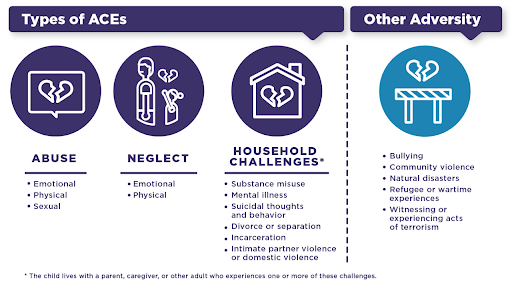
Adverse Childhood Experiences (ACEs) are potentially traumatic events such as abuse, neglect, household challenges, or other adversities that happen during childhood. The ACE framework is used as a professional tool to understand a person's risk for long-term physical and mental health struggles. Data collected from ACE assessments helps professionals design trauma-informed care, and implement interventions. Ultimately, it serves as a roadmap for building targeted support systems that foster resilience.
For more information:
Impact on Brain Development
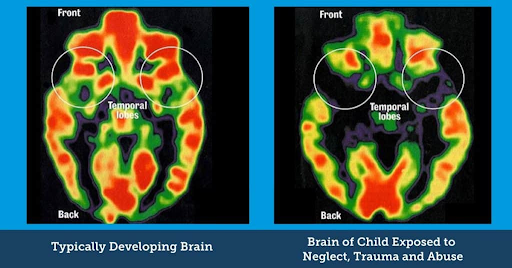
When young children experience ongoing trauma, their brains actually rewire for survival by enlarging the "alarm center" (the amygdala) and shrinking the area responsible for memory (the hippocampus). This shifts someone from logical problem-solving to constant survival mode. Safe situations can suddenly feel like major threats, triggering intense fight, flight, freeze, or fawn reactions. Decision-making becomes highly impulsive and focused entirely on surviving in the present moment. What looks like harmful and maladaptive behavior is often the brain doing exactly what it was shaped to do: protect itself at all costs.
A Guide to Toxic Stress-Harvard Center on the Developing Child
Criminalizing Survival Behaviors

When justice systems overlook trauma, it often ends up punishing children for simply trying to survive. Many systems default to criminalizing the coping mechanisms that adolescents develop to navigate neglect, abuse, household challenges, or community violence. Society criminalizes survival behaviors such as running away from an abusive home, fighting, theft for basic needs, truancy, or forced criminal acts. The emotional dysregulation caused by trauma such as outbursts or turning to substances to numb psychological pain is often recognized as criminal but not viewed as maladaptive coping skills. By treating these survival strategies as willful criminal acts, we trap youth in a cycle that worsens their trauma instead of providing the trauma-informed care they need.
Human Rights for Kids:
Childhood Trauma-to-Prison Pipeline Report
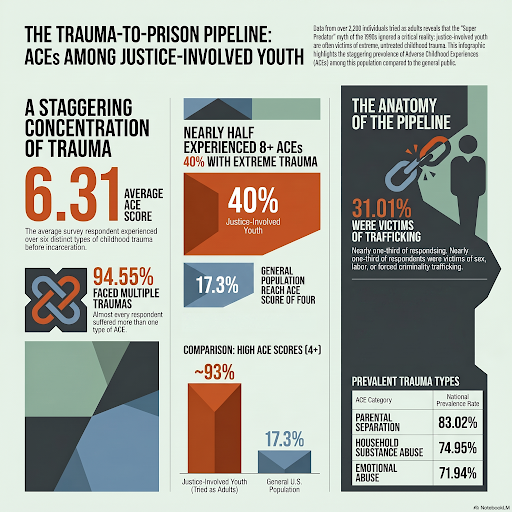
To access the full report: Click Here
Rewriting The Story: Impacts for Lasting Change
Although trauma cannot excuse the harm that is done with criminal behavior, it is part of explaining the behavior that can be used to streamline prevention and restorative efforts. A focus on mental health and advocacy for justice-involved youth can create foundations of connection and resilience that have lasting implications.
Breaking the cycle begins with:
Behavior supports
Restorative practices
Early Interventions
Access to quality mental health services
Trauma-Informed Justice Programs
Trauma screenings
Therapeutic and clinical interventions
A focus on Rehabilitation vs Punishment