Collection: The Art of Negotiation, Boundaries, and Consent
Estella Borden
22 May, 2026
Through my experiences within the kink community, in moments where light was dimmed, music thumped, and moans echoed throughout the room, and on nights where we played card games in lingerie and kissed each other in closets, I have learned that consent and negotiation are basic social skills rooted in conversations about autonomy and respect for individual identity and safety. Kink communities have spent decades developing language and practices that emphasize the role of consent and negotiation due to the intensity, associated risk, and subsequent psychological and physiological vulnerability that often coincide with BDSM interactions. Different dynamics require different, ongoing conversations about boundaries. And these tools are valuable within “vanilla” contexts too.
Whether someone is negotiating a BDSM dynamic, deciding how they want to be touched after a hard day, or establishing emotional boundaries in a monogamous relationship, core principles of consent stay the same:
1. Consent is not, simply, the absence of resistance.
Consent is informed, reversible, ongoing, and enthusiastic.
2. Consent can look different across cultures, identities, and relationships.
Some individuals communicate rather directly. Others rely more on tone and body language. Neurodivergent individuals might rely more on explicit agreements rather than implied social and body cues. Everyone is different. There is no “correct” way to negotiate consent, as long as it is clear and explicit.
Verbal and Nonverbal Consent
Verbal consent will always be the safest option to communicate, and it prevents misunderstandings and unintentional harm. Although, we must recognize that individuals may not always be able to express verbal consent within kink if they are wearing gear or participating in practices that impact verbal communication. Perhaps someone is wearing a gag, mask, or hood. Perhaps they are actively engaging in breath play. These are the many situations in which nonverbal cues and established signals may come in handy to demonstrate consent, or withdrawal thereof.
Examples of enthusiastic verbal consent:
“Yes, oh yes please!”
“Keep doing that.”
“I want this.”
Verbal examples of consent withdrawal:
“Slow down, I don’t like it that hard.”
“Stop. I’m done.”
“Please don’t pull my hair anymore.”
Examples of Nonverbal consent:
An individual may give a clear thumbs up.
An individual may nod “Yes.”
Nonverbal examples of consent withdrawal:
Shaking their head repeatedly, “No.”
Tapping repeatedly on an arm.
Giving a pre-established hand signal.
Additionally, all of these nonverbal signals may change and fluctuate according to the individual. It is important that if engaging in play where nonverbal signals may need to be used, that they are established and are clear markers of consent and withdrawal thereof. For example, I have engaged in rope play that has involved full body incapacitation, including rope in my mouth. My nonverbal signal, as we kept my neck movement free, was a firm shaking of my head repeatedly, “NO.”
Negotiation and Consent Before Kink
The process of obtaining consent on certain behaviors and acts is called “Negotiation” and occurs in kink communities before a play begins. Partners discuss hard and soft limits, goals for the play, aftercare needs, and safewords. Vanilla relationships can benefit from the same mindset.
Negotiation can sound like:
“I’m okay kissing tonight, but I don’t want to have sex.”
“I like dirty talk, but degradation is off limits.”
“I want affection, but I don’t want unexpected touch.”
“I want this play to be sensual and rough.”
“I want to achieve orgasm from this play.”
“I want you to eat me out for ten minutes, then put me in a cage for five minutes, and then smack me on the butt a few times.”
The STOPLIGHT System
A recognizable tool within BDSM and kink communities is the STOPLIGHT system, which has grown to be a convenient standard when discussing safewords within play. It provides a quick framework (red, yellow, green) to gauge comfortability on the go. It can be used by both dom and sub type individuals and follows these general parameters:
Saying “Green” signals active consent and enjoyment of what is occurring.
Saying “Yellow” may signal that an individual is reaching their threshold. This is them waving their “caution” flag, and that they may need to slow down, check-in, and reassess.
Saying “Red” means STOP IMMEDIATELY and move into established aftercare.
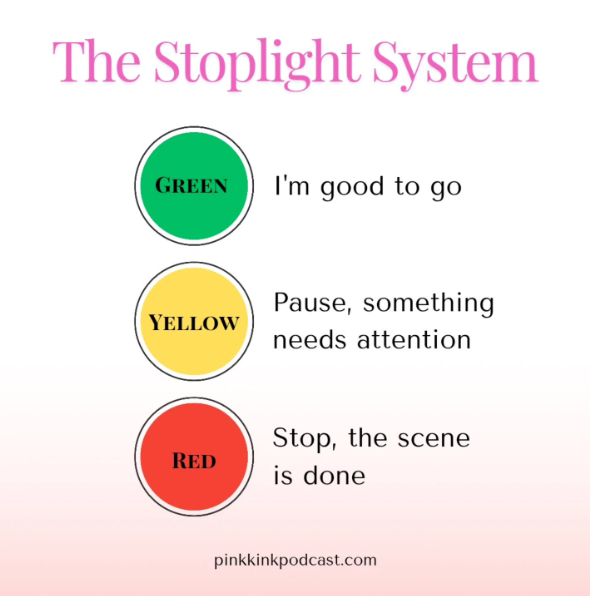
Image credits: PinkKinkPodcast
I think it is important to know that the Stoplight System, while providing a lovely foundation, may not look quite the same for everyone. While someone may use “yellow” to communicate a need to stop and check-in, another may use it to simply say “slow down.” It is important to understand this nuance.
Additionally, Dr. Betty Martin’s Wheel of Consent is a valuable resource that delves into the types of consent and negotiation- the “doing” and the “receiving” of any interaction between two or more people. Each type of interaction looks different, and requires a different level of negotiation. For example: If I were to touch my partner how I want, this qualifies as 1) Something I am doing, and 2) Something I am doing for me. This would require a discussion into my receiving partners boundaries for touch, to make sure I am not overstepping in any way.
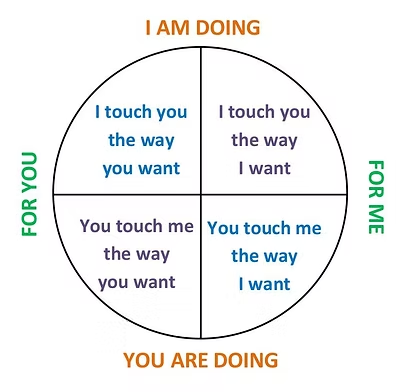
Image credits: Dr. Betty Martin, https://www.artofconsent.co.uk/wheel-of-consent
Social Context of Consent
We must understand that consent conversations do not happen in a vacuum. Dynamics of power inevitably shape the way we negotiate and express consent. Factors that may influence an individual's ability to negotiate freely may include but are not limited to:
Economic dependence
Disability
Religion
Trauma history
Neurodivergence
Community pressure
Minority stress
Experiences of racism, sexism, homophobia, and more.
Relationship hierarchy
It is my firm opinion that ethical negotiation must address power imbalances, existing trauma, disorders, and disabilities, soft and hard limits, and etc. in any relationship (especially within contexts of BDSM power exchange). Recognizing these realities may offer clarity and promote healthy decision making.
Remember, consent and negotiation should always be informed, enthusiastic, and ongoing.
Stay safe, sane, and consensual everyone!
Your experiences, perspectives, and questions matter. If you have thoughts on this topic, disagreements, concerns, or suggestions for future discussions, don’t hesitate to reach out to us. All interactions are strictly confidential unless explicit permission is given.
Need to contact me?
Estella Borden
M.S. Counseling Intern
The Expansion Collective Therapy | www.expansioncollectivetherapy.com
estella@expansioncollectivetherapy.com
(574) 903-7742